



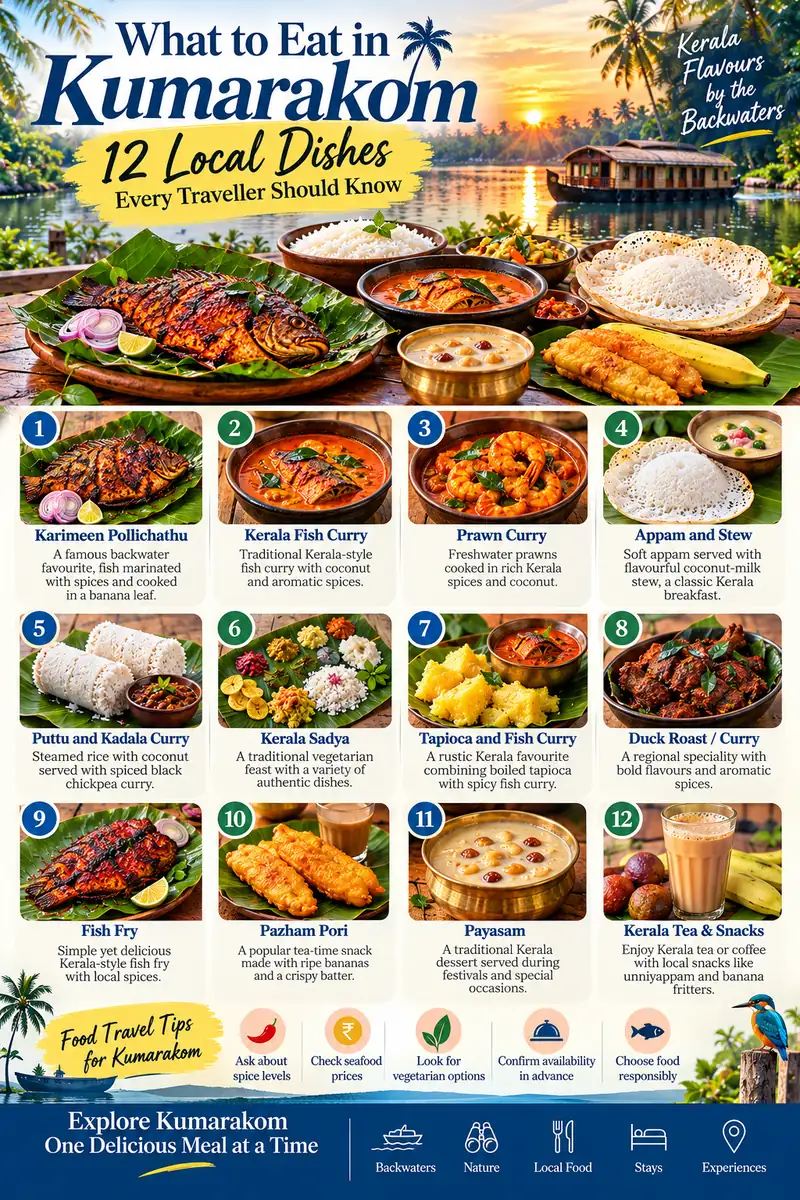
What to Eat in Kumarakom: 12 Local Dishes Every Traveller Should Know
Kumarakom is known for the peaceful backwaters of Vembanad Lake, coconut-lined canals and traditional village life. But there is another reason to explore this beautiful destination: its food.
The food in Kumarakom reflects the landscape around it. Rice, coconut, freshwater fish, prawns, aromatic spices and seasonal vegetables play an important role in traditional Kerala cooking. From karimeen pollichathu served in a banana leaf to soft appam with coconut-milk stew, local meals offer travellers a delicious introduction to the region’s culinary traditions.
Whether you are planning a weekend getaway, a family holiday or a longer Kerala backwater trip, knowing what to order can make your visit more memorable.
Here are 12 traditional Kerala dishes and food experiences to look for when visiting Kumarakom.
1. Karimeen Pollichathu: A Famous Backwater Favourite
If you enjoy seafood, put karimeen pollichathu near the top of your food list.
Karimeen, commonly known as pearl spot, is a fish associated with Kerala’s backwaters. In this preparation, the fish is coated with a mixture of spices, herbs and aromatics, wrapped in a banana leaf and cooked until the flavours come together.
The banana leaf helps retain moisture while adding a distinctive aroma to the dish. Depending on the cook and recipe, the result can be spicy, savoury and slightly smoky.
Karimeen pollichathu is commonly associated with the cuisine of Kumarakom and the wider Vembanad region.
How to enjoy it: Order it with steamed rice or a traditional Kerala meal. Ask about the fish size, preparation method and price before ordering, as portions and prices vary between establishments.
Who should try it: Seafood lovers and travellers interested in regional Kerala cuisine.
2. Kerala Fish Curry: A Taste of Traditional Home Cooking
Kerala fish curry is another dish worth seeking out in Kumarakom.
Recipes differ across the state. Some use a tangy, red chilli-based gravy, while others incorporate coconut milk or freshly ground coconut. Curry leaves, ginger, garlic and other spices contribute to the flavour.
Fish curry is often served with rice, making it a satisfying lunch option after a morning of sightseeing or boating.
Do not assume every restaurant prepares fish curry in the same way. Asking whether the gravy is coconut-based, tangy or particularly spicy can help you choose a version you will enjoy.
How to enjoy it: Try it with Kerala matta rice, a traditional parboiled rice variety, if available.
Who should try it: Travellers who want a traditional rice-and-curry meal rather than a restaurant-style seafood platter.
3. Freshwater Prawn Curry: A Rich and Flavourful Dish
Prawns feature in many Kerala seafood preparations, including dishes served around the backwaters.
A traditional prawn curry may combine prawns with coconut, chilli, curry leaves and aromatic spices. Some versions have a creamy gravy, while others are sharper and more tangy.
Prawn preparations can vary according to local recipes and the ingredients available that day.
How to enjoy it: Pair prawn curry with steamed rice or appam. Ask whether the prawns are fresh or frozen and whether the dish contains coconut milk.
A useful tip: Confirm the portion size and price before ordering, particularly when seafood is charged separately from a meal.
4. Appam and Stew: A Classic Kerala Breakfast
Appam is one of Kerala’s best-known rice-based dishes. It has a soft centre and delicate, lacy edges, created by cooking fermented rice batter with coconut-based ingredients.
It is often served with stew, which may contain vegetables, chicken or other ingredients depending on the kitchen.
Vegetable stew usually features a mild, aromatic coconut-milk gravy. Its gentle flavour balances the texture of freshly prepared appam.
For travellers who prefer a less spicy breakfast, appam with vegetable stew can be an excellent choice.
How to enjoy it: Eat appam while it is warm and soft, with plenty of stew to accompany each piece.
Who should try it: Families, couples and anyone looking for a comforting Kerala breakfast.
5. Puttu and Kadala Curry: A Traditional Breakfast Combination
Puttu is a steamed rice preparation traditionally layered with grated coconut. It is cylindrical in shape and has a soft, crumbly texture.
One popular accompaniment is kadala curry, a black chickpea curry prepared with spices and, in many recipes, coconut.
Together, the dishes provide a filling breakfast with a combination of rice, legumes and coconut.
Some kitchens also serve puttu with green gram, banana or other accompaniments.
How to enjoy it: Mix small portions of puttu with the curry as you eat. Ask whether the curry is spicy before ordering if you prefer milder food.
Who should try it: Vegetarians, breakfast enthusiasts and travellers who want to experience everyday Kerala food.
6. Kerala Sadya: A Traditional Vegetarian Feast
Kerala sadya is a festive vegetarian meal traditionally served on a banana leaf.
Depending on the occasion and menu, it can include rice, sambar, avial, thoran, olan, pachadi, pickles, papadam and payasam.
Each preparation contributes a different texture and flavour. Some dishes are mildly seasoned, others are tangy, and several use coconut in different forms.
Sadya is particularly associated with festivals, celebrations and special occasions. It is not necessarily available as a full traditional spread at every restaurant every day.
How to enjoy it: Ask whether a complete sadya is available and whether it needs advance booking. Confirm the dishes included and whether the meal is served on the day you plan to visit.
Who should try it: Vegetarian travellers and anyone interested in Kerala’s food traditions.
7. Tapioca and Fish Curry: A Rustic Kerala Favourite
Tapioca, known locally as kappa, is a familiar part of Kerala’s food culture.
Boiled and seasoned tapioca has a soft, slightly dense texture. It is often served alongside a spicy fish curry, creating a combination of mild starch and bold gravy.
The dish is associated with traditional home cooking and is enjoyed in different parts of Kerala.
In Kumarakom, it is worth asking local restaurants whether kappa and fish curry are available on their menu.
How to enjoy it: Try a small portion first if you are unfamiliar with tapioca or prefer lighter meals.
Who should try it: Travellers interested in everyday regional food beyond familiar restaurant dishes.
8. Duck Roast and Duck Curry: A Speciality to Look For
Duck preparations are part of the culinary traditions of central Kerala and the wider backwater region.
Depending on the recipe, duck may be cooked slowly with onions, black pepper, chillies and other spices. Some preparations have a thick, dark gravy, while others are drier and more roasted.
Duck dishes are often richer and more strongly flavoured than a simple vegetable stew.
How to enjoy it: Ask whether the kitchen serves duck roast, duck curry or duck mappas, as these are different preparations. Check the portion size and spice level.
Who should try it: Travellers who enjoy meat dishes and want to explore more regional Kerala cooking.
9. Fish Fry: A Simple Way to Enjoy Local Seafood
Sometimes, a straightforward preparation is all you need.
Kerala-style fish fry commonly uses a spice marinade containing ingredients such as chilli, turmeric, ginger, garlic and pepper. The fish is then fried until the exterior becomes crisp.
The type of fish, marinade and cooking method vary between kitchens.
Fish fry can be served as a side dish with rice or ordered as part of a larger seafood meal.
How to enjoy it: Ask which fish is available, whether it is served whole or in pieces, and how much the portion costs.
A practical tip: If you have allergies or dietary restrictions, tell the restaurant before placing your order.
10. Pazham Pori: A Favourite Tea-Time Snack
Pazham pori, also called banana fritters, is a popular Kerala snack made by coating ripe banana slices in batter and frying them.
The outside develops a light crispness, while the banana inside becomes soft and sweet.
It is often enjoyed with tea or coffee in the afternoon. The combination makes a pleasant break between sightseeing activities.
How to enjoy it: Look for freshly prepared fritters and eat them while they are warm.
Who should try it: Families, snack lovers and visitors looking for something simple between meals.
11. Payasam: A Traditional Kerala Dessert
Payasam is a traditional sweet dish served during celebrations, family gatherings and festive meals.
Depending on the recipe, it may be prepared using rice, vermicelli, lentils or other ingredients, combined with milk or coconut milk and sweetened accordingly.
Some varieties are creamy, while others have a thinner consistency and a distinctive flavour from jaggery, cardamom or other ingredients.
Payasam is frequently included in a traditional sadya, but availability varies by restaurant and occasion.
How to enjoy it: Ask which variety is being served and whether it contains milk, nuts or other ingredients relevant to your diet.
Who should try it: Anyone interested in traditional Kerala sweets.
12. Kerala Tea, Coffee and Local Snacks
Not every food experience needs to be a large meal.
A tea break offers an easy way to slow down and enjoy the rhythm of the backwater region. Depending on the establishment, you may find Kerala-style tea, coffee, banana fritters, unniyappam or other local snacks.
Unniyappam is a small, sweet preparation generally made using rice, banana, jaggery and other ingredients, with recipes varying by household and region.
Local snack availability depends on the shop and time of day, so ask what has been freshly prepared.
How to enjoy it: Take an afternoon break after exploring the village or return from a boat ride and look for a nearby tea shop.
Vegetarian Food in Kumarakom: What Should You Order?
Kumarakom is not only a destination for seafood lovers. Kerala’s traditional cooking offers plenty of vegetarian options.
Look for these dishes when planning your meals:
- Appam and vegetable stew: A mild and comforting combination.
- Puttu and kadala curry: A filling breakfast made with rice and chickpeas.
- Kerala sadya: A traditional vegetarian meal with several accompaniments.
- Avial: Mixed vegetables cooked with coconut and seasonings.
- Thoran: Vegetables prepared with grated coconut and spices.
- Dosa and idli: Rice-based breakfast options commonly found across Kerala.
- Pazham pori: A sweet banana snack.
- Payasam: A traditional dessert available in different varieties.
If you are vegan, ask about dairy, ghee, curd and other animal-derived ingredients. Coconut milk does not automatically mean that every dish is vegan.
If you have a food allergy, communicate it clearly to the restaurant and confirm how the food is prepared.
Where Can You Find Traditional Food in Kumarakom?
The best place to eat depends on your budget, dietary preferences and the kind of experience you want.
Local restaurants and small eateries
These can be useful places to look for everyday Kerala meals, breakfast dishes and traditional snacks. Menus, hygiene standards, opening hours and availability differ, so check before travelling specifically to an establishment.
Lakeside restaurants
Some restaurants near Vembanad Lake offer views of the backwaters alongside Kerala and other cuisines.
They can suit travellers who want to combine a meal with a scenic setting. However, a lakeside location does not guarantee that every dish is traditional or locally sourced.
Hotel and resort restaurants
Hotels and resorts may offer Kerala specialities alongside Indian and international dishes. Ask about the menu, meal timings and whether specific dishes need advance notice.
Houseboat meals
Some houseboat packages include meals featuring Kerala cuisine. The menu and inclusions vary between operators.
Before booking, confirm which meals are included, whether vegetarian or special-diet options are available, and whether any seafood dishes cost extra.
Planning tip: Visit Kumarakom’s backwater travel guide to explore the destination alongside your food plans. For a list of actual restaurants, verify current menus, operating hours and locations before publication.
A Simple One-Day Food Trail in Kumarakom
If you want to explore local food without spending your entire holiday in restaurants, use this flexible outline.
Breakfast: Start with a Kerala classic
Try appam with vegetable stew or puttu with kadala curry. These dishes offer a good introduction to traditional Kerala breakfast.
Late morning: Explore the backwaters
Enjoy a suitable boat experience or explore the village, depending on your interests and the weather.
Lunch: Choose a traditional Kerala meal
Look for Kerala fish curry with rice, karimeen pollichathu or a vegetarian sadya if one is available. Ask about the menu and prices first.
Afternoon: Take a tea break
Try tea or coffee with pazham pori or another locally prepared snack.
Dinner: Finish with a dish you have not tried
Consider prawn curry, duck roast, appam and stew, or another regional preparation. Choose according to your dietary needs and appetite.
Treat this as a flexible suggestion rather than a fixed itinerary. You can swap meals, shorten the day or choose vegetarian alternatives.
What Should You Know Before Ordering Food in Kumarakom?
A little preparation can make dining easier, especially if you are unfamiliar with Kerala cuisine.
Ask about spice levels. Some curries are mild, while others use plenty of chilli and pepper.
Confirm seafood prices. Fish and prawns may be priced by portion or weight. Ask how much you will pay before ordering.
Check availability. Traditional dishes may not be prepared every day. Call ahead if you are visiting specifically for karimeen pollichathu, sadya or duck curry.
Mention dietary needs. Tell the kitchen about allergies, vegetarian preferences and restrictions before the food is prepared.
Ask about ingredients. Coconut, dairy, nuts, seafood and other ingredients may be used in ways that are not obvious from a dish’s name.
Choose food responsibly. Ask about the origin of seafood if sourcing matters to you. Avoid assuming that all fish served in a backwater restaurant was caught locally or on the same day.
Respect local customs. If you visit a family-run establishment or community food experience, ask permission before photographing people or entering private areas.
Frequently Asked Questions About Food in Kumarakom
What is the most famous food in Kumarakom?
Karimeen pollichathu is one of the best-known dishes associated with Kumarakom and the Vembanad backwaters. It features pearl spot fish marinated with spices and cooked in a banana leaf.
Is Kumarakom good for seafood?
Kumarakom is known for backwater cuisine, including fish and prawn preparations. Availability, sourcing and preparation vary by restaurant, so check the menu before visiting.
What vegetarian food is available in Kumarakom?
Common options include appam with vegetable stew, puttu with kadala curry, dosa, idli, avial, thoran and Kerala sadya when available.
What is a typical Kerala breakfast in Kumarakom?
Appam with stew, puttu with kadala curry, dosa and idli are familiar Kerala breakfast choices. The dishes available depend on the establishment.
Is Kerala food always spicy?
No. Some dishes are mild and coconut-based, while others use chilli, pepper and tangy ingredients. Ask the restaurant about spice levels before ordering.
Can I find traditional Kerala food on a houseboat?
Some houseboat packages include Kerala-style meals. Confirm the menu, meal inclusions, dietary options and additional charges with the operator before booking.
What should I eat if I have only one meal in Kumarakom?
Choose according to your preferences. Seafood lovers might try karimeen pollichathu or fish curry with rice, while vegetarians could look for a Kerala sadya or appam with vegetable stew.
Experience Kumarakom Through Its Food
Food is a useful way to understand the traditions and everyday life of a destination. In Kumarakom, a meal can introduce you to familiar Kerala staples, regional seafood preparations and festive vegetarian dishes.
Try something beyond your usual order. Ask how a dish is prepared, learn about its ingredients and leave room for an unexpected favourite.
When planning your visit, combine local food with the backwaters, village scenery and other experiences that make Kumarakom distinctive.
Planning a trip to Kumarakom? Explore the destination guides and travel ideas on VisitKumarakom.com to plan a backwater holiday that suits your interests.
0 Comment