

Every year, as the monsoon rains rejuvenate Kerala’s wetlands, a quiet village near Kottayam undergoes an extraordinary transformation. Vast stretches of paddy fields become covered with thousands of pink and white water lilies, creating one of India’s most spectacular seasonal landscapes. This breathtaking phenomenon is known as the Malarikkal Water Lily Bloom, or locally, Aambal Vasantham.
Located in the heart of Kerala’s Kuttanad region, Malarikkal has rapidly emerged as one of the state’s most sought-after eco-tourism destinations. What was once a peaceful agricultural village known primarily to local farmers is now attracting photographers, nature lovers, birdwatchers, influencers, researchers, and travelers from around the world.
Unlike many tourist attractions that rely on artificial development, Malarikkal’s appeal lies entirely in its natural beauty. During the blooming season, the flooded paddy fields resemble a giant pink carpet stretching toward the horizon. Traditional country boats glide silently through the waterways, early morning mist floats above the wetlands, and the rising sun paints the landscape in shades of gold and pink.
The Malarikkal bloom is far more than a beautiful photography destination. It represents a fascinating intersection of ecology, agriculture, history, culture, and sustainable tourism. The story of Malarikkal involves ancient kingdoms, unique below-sea-level farming systems, ecological transformations triggered by floods, and the remarkable resilience of Kerala’s wetland communities.
Today, the annual bloom generates significant income for local families while simultaneously raising important questions about wetland conservation, biodiversity, and the future of agriculture in the Kuttanad region.
This comprehensive guide explores everything travelers need to know about Malarikkal, including its history, ecological significance, travel information, photography opportunities, and practical tips for experiencing one of Kerala’s most enchanting natural wonders.
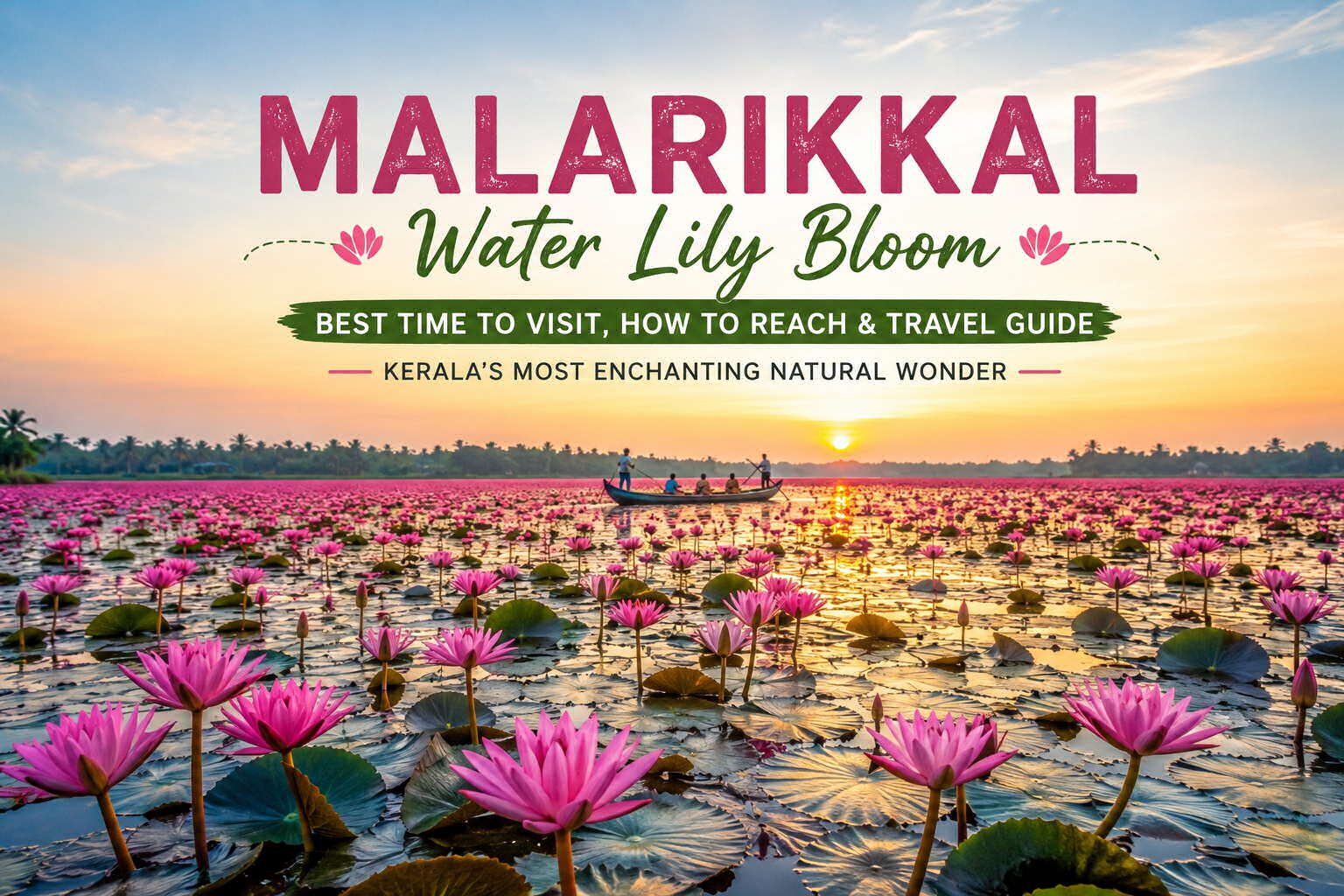
Malarikkal Water Lily Bloom is a seasonal natural phenomenon where thousands of water lilies blossom across flooded paddy fields in Malarikkal village near Kottayam, Kerala. The bloom typically occurs between July and October, with peak flowering during August and September.
The best time to visit Malarikkal is from mid-August to late September, when the water lilies are at their peak bloom.
For the best experience:
The blooming season generally starts in July and continues until October. However, the intensity of the bloom depends on rainfall, water levels, and monsoon conditions.
Yes.
Malarikkal is located in the Thiruvarpu Panchayat of Kottayam District in Kerala.
Distances:
Visitors can reach Malarikkal via:
Nearest Railway Station:
Nearest Airport:
Until recently, Malarikkal remained largely unknown outside the Kottayam district.
Although water lilies had existed in the region for generations, few people beyond the local farming community paid attention to them. The village’s economy revolved primarily around paddy cultivation and small-scale agriculture.
Everything changed in 2018.
During the post-monsoon season, photographs of newly married couples posing amid vast fields of pink water lilies began circulating across social media platforms. The images quickly went viral, capturing the imagination of travelers across India.
The photographs looked almost surreal.
Endless pink flowers floating on calm water.
Traditional wooden boats.
Morning mist.
Golden sunrise reflections.
Palm-lined horizons.
The images showcased a side of Kerala that many travelers had never seen before.
Tourism numbers surged almost overnight.
Photographers arrived from major cities.
Travel bloggers began featuring Malarikkal.
Tour operators added the destination to Kerala itineraries.
Within a few years, Malarikkal transformed into one of Kerala’s most talked-about seasonal attractions.
The rise of Malarikkal also demonstrated the power of digital tourism marketing. Unlike many destinations promoted through expensive campaigns, Malarikkal gained fame primarily through organic social media sharing.
Today, it is considered one of Kerala’s top monsoon tourism destinations.
Malarikkal is situated within the famous Kuttanad region of Kerala.
The village lies in Thiruvarpu Panchayat of Kottayam District and forms part of the larger Vembanad wetland ecosystem.
This location is particularly significant because Kuttanad is one of the few places in the world where farming takes place below sea level.
The region is characterized by:
Malarikkal occupies a strategic position where the Meenachil and Kodoor rivers interact with the broader Vembanad Lake system.
This unique geography creates ideal conditions for seasonal flooding, which in turn supports the annual water lily bloom.
Because of its proximity to Kumarakom, many visitors combine both destinations into a single trip.
Long before becoming a famous tourism destination, Malarikkal played an important role in Kerala’s political and military history.
Its strategic location within the Vembanad backwater network made it a valuable frontier settlement.
The waterways that attract tourists today once served as vital trade routes transporting:
Control over these waterways meant economic power.
As a result, several kingdoms competed for influence in the region.
The name “Malarikkal” is believed to originate from the Malayalam word Malari.
A malari refers to a distinctive hydrological phenomenon where underwater currents push water outward with unusual force.
This phenomenon historically occurred when the swollen monsoon-fed rivers met the backwaters of Vembanad Lake.
Ancient traders and travelers navigating these waterways frequently encountered these powerful currents.
Over time, the region became associated with this unique water movement, eventually giving rise to the name Malarikkal.
The connection between the village and water remains central to its identity even today.
During the medieval period, Malarikkal formed part of the Thekkumkoor Kingdom.
Thekkumkoor was one of the major principalities of central Kerala and controlled extensive territories around present-day Kottayam.
Because Malarikkal sat near important waterways, it became a strategic frontier settlement.
The kingdom relied heavily on water transport for trade and military logistics.
Boats carrying valuable goods regularly passed through the region.
To protect these trade routes, the rulers established military outposts and defensive structures near Malarikkal.
Among these structures, none was more important than the famous Malarikkal Fort.
The Malarikkal Fort once stood as a symbol of the region’s strategic importance.
Unlike traditional stone forts found elsewhere in India, the Malarikkal Fort was specifically designed for a wetland environment.
Its architecture included:
The fort’s primary purpose was to monitor movements along the waterways and defend against rival kingdoms.
From this strategic position, soldiers could observe boats approaching through the interconnected backwater channels.
The fort helped ensure Thekkumkoor’s control over trade routes linking inland Kerala with the Vembanad Lake system.
Unfortunately, the fort’s importance would eventually draw it into one of the most significant conflicts in Kerala’s history.
By the mid-18th century, the Kingdom of Travancore was rapidly expanding under the leadership of Maharaja Marthanda Varma.
Travancore sought to unify much of Kerala under its control.
One of the major obstacles to this ambition was Thekkumkoor.
In 1749, Travancore launched a major military campaign against Thekkumkoor.
The operation was led by:
The battle at Malarikkal became a decisive moment in the conflict.
Travancore forces overwhelmed the defenders.
Historical records indicate that numerous naval vessels were captured during the campaign.
The Malarikkal Fort was destroyed.
Thekkumkoor lost control of the region.
Malarikkal was subsequently incorporated into the expanding Travancore Kingdom.
This event marked the end of Malarikkal’s role as a military frontier and the beginning of its evolution into an agricultural landscape.
The history of Malarikkal reveals a remarkable pattern.
Water has always defined the village.
It shaped:
Today, the same waterways that once carried armies and merchant vessels carry visitors seeking the beauty of the annual water lily bloom.
The transformation from a strategic military outpost to a globally recognized eco-tourism destination is one of the most fascinating chapters in Kerala’s history.
While most visitors are captivated by the stunning pink landscape, the Malarikkal Water Lily Bloom is much more than a visual attraction. It represents a complex interaction between wetlands, agriculture, hydrology, biodiversity, climate, and human intervention.
The bloom serves as a living example of how ecological systems can adapt and evolve in response to environmental changes. Scientists, conservationists, and agricultural experts continue to study Malarikkal because it provides valuable insights into wetland ecosystems and sustainable land management.
The annual bloom demonstrates both the beauty and complexity of Kerala’s unique Kuttanad landscape.
Malarikkal forms part of the globally significant Kuttanad region, often called the “Rice Bowl of Kerala.”
Kuttanad is internationally recognized because it is one of the few places in the world where farming takes place below sea level.
The region is characterized by:
These ecosystems support a rich diversity of:
The health of these interconnected systems directly influences the success of agriculture, tourism, and biodiversity conservation.
The water lily bloom is one visible expression of this larger ecological network.
The spectacular floral display seen in Malarikkal consists primarily of aquatic plants belonging to the Nymphaeaceae family.
Commonly known as:
This species has traditionally existed throughout Kerala’s wetlands and backwaters.
Recent ecological studies suggest that much of the dramatic pink bloom now dominating Malarikkal is associated with this vigorous hybrid species.
Characteristics include:
The combination of these species creates the iconic pink and white landscape that visitors admire each year.
The answer lies in a combination of environmental and agricultural factors.
Water lilies thrive under specific conditions:
The flooded paddy fields of Malarikkal provide precisely these conditions after the monsoon season.
Seeds remain dormant in the soil during cultivation periods.
When fields become flooded again, these seeds germinate rapidly, producing thousands of flowers within weeks.
This natural cycle has occurred for generations.
However, the dramatic expansion of the bloom in recent years is linked to a much larger environmental event.
One of the most significant turning points in the history of the bloom occurred during the devastating Kerala floods of 2018.
The floods were among the worst natural disasters in the state’s history.
Massive volumes of water swept across Kuttanad and surrounding regions.
While the floods caused enormous destruction, they also triggered unexpected ecological changes.
Scientists believe the floodwaters altered the chemical composition of the soil in several ways.
Kuttanad soils are known for containing acid sulphate deposits.
These acidic conditions can limit the growth of many aquatic plants.
The floodwaters helped:
As floodwaters receded, they deposited fresh layers of fertile alluvial sediment.
These sediments contained:
The enriched soil created ideal conditions for water lily growth.
The combination of:
created an environment where water lilies could flourish on an unprecedented scale.
Many researchers identify the 2018 floods as a major catalyst behind Malarikkal’s explosive floral expansion.
Another important factor influencing the bloom is the Thanneermukkam Salt Water Barrier.
This structure was originally designed to protect Kuttanad agriculture from saline intrusion.
By restricting saltwater movement from the Arabian Sea, the barrier allows farmers to cultivate rice more effectively.
However, environmental experts suggest that prolonged closure of the barrier has altered the natural ecological balance.
Historically:
Today:
This illustrates how human-engineered water management systems can influence ecological processes in unexpected ways.
Despite ongoing debates about its environmental impacts, the bloom provides several ecological benefits.
Water lilies attract large numbers of pollinators.
Researchers have documented:
These insects contribute to broader ecosystem health and support nearby agricultural crops through pollination.
The dense lily pads provide:
for numerous aquatic organisms.
These include:
The floating vegetation creates microhabitats that enhance biodiversity.
The wetlands surrounding Malarikkal support many bird species.
Common visitors include:
The water lilies create favorable feeding and nesting environments.
Birdwatchers often combine visits to Malarikkal with trips to the nearby Kumarakom Bird Sanctuary.
The extensive coverage of lily pads blocks sunlight from reaching the water below.
This naturally suppresses the growth of competing weed species.
As a result:
This is one of the lesser-known ecological services provided by the bloom.
Although beautiful, the water lily expansion is not entirely beneficial.
Several ecological concerns have emerged.
Dense mats of vegetation can restrict oxygen exchange between water and the atmosphere.
This can lead to:
Some local fishermen report reductions in fish catches.
Possible reasons include:
The long-term effects remain under study.
At the end of the blooming season, large quantities of plant material decompose.
This decomposition process releases methane.
Methane is a potent greenhouse gas.
While the overall impact requires further research, scientists recognize this as an important environmental consideration.
The abundance of seeds and plant material provides food for rodents.
Consequently:
This highlights the interconnected nature of ecological systems.
For tourists, the water lilies represent beauty and tranquility.
For many farmers, they represent a persistent challenge.
The same flowers that generate tourism revenue can also interfere with agricultural operations.
Farmers must clear the vegetation before planting rice.
This often requires:
The process adds costs and complexity to agricultural production.
Yet tourism generated by the bloom can provide substantial income.
This creates a unique paradox.
The water lilies are simultaneously:
Balancing these competing perspectives remains one of Malarikkal’s greatest challenges.
The rise of water lily tourism has transformed the local economy.
Before the bloom gained international attention, income opportunities during the agricultural off-season were limited.
Today, tourism generates revenue through:
Traditional country boats have become one of the area’s biggest attractions.
Many operators earn significant seasonal income through guided rides.
Local families now host visitors seeking authentic village experiences.
Temporary stalls offer:
Residents convert available land into temporary parking areas.
Professional photographers organize:
Economic studies suggest that Malarikkal’s tourism industry now contributes crores of rupees annually to the local economy.
Recognizing the importance of the bloom, local authorities and Kerala Tourism introduced the Aambal Vasantham Festival.
The festival aims to:
Activities often include:
The festival has helped transform Malarikkal into a structured eco-tourism destination rather than an unmanaged tourist hotspot.
The future success of Malarikkal depends on balancing three critical priorities:
The ecological health of the Kuttanad wetlands must remain a priority.
Without healthy wetlands:
Rice cultivation remains essential for:
Tourism should complement agriculture rather than replace it.
As visitor numbers continue to increase, authorities must address:
Responsible tourism practices will be crucial for preserving the destination’s unique character.
Malarikkal is more than a beautiful travel destination.
It is a living example of how natural ecosystems, local communities, agriculture, and tourism can interact in complex ways.
The bloom tells a story about:
Visitors who arrive seeking beautiful photographs often leave with a deeper appreciation for Kerala’s extraordinary environmental heritage.
One of the most frequently searched questions about Malarikkal is: “When is the best time to visit?”
The answer depends on both the season and the time of day.
The annual bloom generally begins after the Southwest Monsoon and continues until the paddy fields are prepared for cultivation.
| Month | Bloom Status |
| July | Initial blooming begins |
| August | Peak blooming season |
| September | Best viewing conditions |
| October | Bloom gradually declines |
| November to June | No significant bloom |
For most visitors, August and September provide the most spectacular experience.
During this period, vast sections of the flooded fields are covered with pink water lilies, creating the famous “pink carpet” effect that has made Malarikkal famous throughout India.
Timing is critical.
Unlike many flowers, water lilies open only during the cooler morning hours.
Visitors arriving late often miss the magical effect entirely.
The difference between visiting at 6:30 AM and 10:30 AM can be dramatic.
Malarikkal is easily accessible from Kottayam, Kumarakom, Kochi, and other major destinations in Kerala.
Distance: Approximately 9 km
Travel Time: 20 minutes
Route:
Kottayam → Thiruvarpu → Kanjiram → Malarikkal
This is the most popular route used by visitors.
Distance: Approximately 10 km
Travel Time: 20 to 25 minutes
Because of its proximity, many visitors choose to stay in Kumarakom and visit Malarikkal early in the morning.
Distance: Approximately 84 km
Travel Time: 1.5 to 2 hours
Recommended routes:
Kottayam Railway Station
Distance from Malarikkal: Approximately 8 km
Cochin International Airport
Distance: Approximately 84 km
Travel Time: Around 2 hours
No visit to Malarikkal is complete without experiencing a traditional country boat ride.
While the bloom can be viewed from the bund roads, the true beauty of the landscape is best appreciated from the water.
As the boat glides through narrow canals, visitors can experience the flowers at eye level while enjoying panoramic views of the surrounding wetlands.
Suitable for:
Suitable for:
Private boats can access quieter sections of the fields where crowd-free photography is possible.
Malarikkal has become one of Kerala’s most photographed destinations.
Every year photographers travel from across India to capture the bloom.
6:00 AM to 7:30 AM
Benefits:
A light drizzle the previous evening often improves photography conditions.
Benefits include:
Modern smartphones perform exceptionally well during golden hour.
Recommended lenses:
Drone photography can reveal the full scale of the bloom.
Always follow local regulations and fly responsibly.
Because the bloom is best viewed at sunrise, staying nearby significantly improves the experience.
The two best accommodation hubs are:
Kumarakom offers a complete Kerala backwater experience while remaining close to the water lily fields.
Advantages include:
Visitors can enjoy Malarikkal at sunrise and spend the rest of the day exploring Kumarakom.
A visit to Malarikkal can easily be combined with several nearby attractions.
Distance: Approximately 13 km
Highlights:
Kerala’s largest lake and the heart of the backwater ecosystem.
Accessible only by boat.
Known for:
One of Kerala’s historic temples with unique traditions.
One of the most important Shiva temples in Kerala.
Famous for its architecture and murals.
Mid-August to late September.
The bloom typically occurs between July and October, peaking in August and September.
Yes. Malarikkal is located in Kottayam district, Kerala.
Travel via Kottayam and Thiruvarpu by road.
Typically around sunrise.
Most flowers begin closing after 9:30 AM.
Yes. Traditional country boats operate during the bloom season.
Yes. It is ideal for families, couples, photographers, and senior travelers.
Most visitors spend between 2 and 4 hours.
Yes. The bloom can be viewed from bund roads and designated viewing areas.
They offer different experiences.
Malarikkal is seasonal and famous for water lilies.
Kumarakom is a year-round backwater destination.
Yes. Local residents provide paid parking during the season.
Viewing from public areas is generally free. Boat rides are charged separately.
Yes. The bloom depends on monsoon conditions.
Yes. Local vendors and restaurants in Kottayam and Kumarakom offer Kerala cuisine.
The Malarikkal Water Lily Bloom is one of Kerala’s most remarkable natural attractions. Every year, the flooded paddy fields of this peaceful village transform into a spectacular landscape of pink blossoms, attracting visitors from around the world.
Beyond its visual beauty, Malarikkal tells a deeper story about Kerala’s wetlands, agricultural heritage, biodiversity, and community-based tourism. The annual bloom demonstrates how nature, culture, and local livelihoods can coexist in a way that benefits both visitors and residents.
Whether you are a photographer searching for the perfect sunrise shot, a traveler exploring hidden gems in Kerala, or a family looking for a memorable experience, Malarikkal deserves a place on your itinerary.
For the best experience, plan your visit during August or September, arrive before sunrise, take a traditional country boat ride, and consider staying in Kumarakom to fully enjoy the beauty of Kerala’s backwaters.
The magical sight of thousands of water lilies floating across the wetlands is an experience that remains unforgettable long after the journey ends.