


Morning in does not announce itself with urgency. It arrives the way breath returns after sleep, slowly, quietly, without demanding attention. There are no horns, no alarms slicing through the dark. Instead, the village seems to wake by agreement, as if everyone and everything has decided together that the night has had enough.
Before sunrise, the air feels suspended. Moist, cool, carrying the faint smell of water plants and wood smoke. Somewhere beyond the darkness lies though at this hour it is more suggestion than sight. The lake breathes mist, and that mist drifts inland, softening edges and muting distance. Houses, palms, jetties, even the horizon itself feel temporary, as if they might dissolve if you stared too long.
This is not a place that rewards haste. Kumarakom reveals itself in fragments, and the morning is when those fragments align. The lake stirs, birds begin their complicated conversations, fishermen move with practiced quiet, and kitchens come alive with fire and tea. By the time the first cup of chaya is poured, the village has fully remembered itself.
To witness a morning here is not to observe a spectacle. It is to notice a rhythm that has never felt the need to impress.
The Lake Before the Sun Arrives
Vembanad in the Hour of Mist
In the hour before sunrise, Vembanad Lake is not a postcard. It is a mood.
The water lies almost flat, disturbed only by the occasional widening circle where a fish breaks the surface. Mist hovers low, thick enough to obscure the opposite bank, thin enough to glow faintly as the sky begins its slow shift from black to deep blue. The boundary between water and air feels uncertain. You could imagine the lake floating upward if the day does not claim it in time.
Standing at the edge, you become acutely aware of small things. The chill on your skin. The quiet lapping of water against stone. The distant creak of a wooden boat adjusting itself to the current. Smell travels differently at this hour. There is damp earth, crushed leaves, the faint sweetness of flowering plants carried across the water.
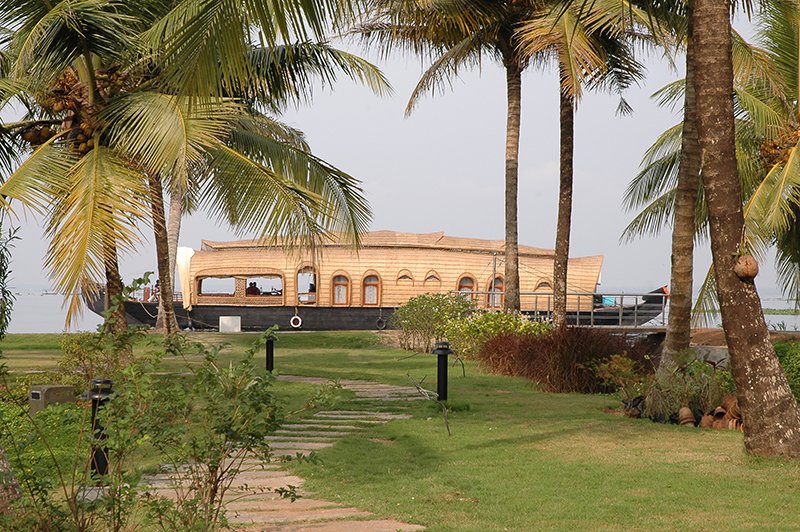
Houseboats, which later will become floating hotels, are barely visible. Their outlines appear and disappear as mist thickens and thins. They look less like vessels and more like memories trying to form. Palms on the far shore rise as silhouettes, tall and motionless, like sentinels that have seen countless mornings arrive this way.
This is the lake without performance. No camera captures it fully because its power lies in what it withholds. You are not meant to consume it quickly. You are meant to stand still long enough for it to accept your presence.
When Birds Announce the Day
Birdsong as the Village Alarm Clock
The first sound does not belong to humans.
It comes sharp and sudden, a single call cutting through the quiet. Then another answers. Within minutes, the air fills with layered sound. Birds do not ease into the morning. They seize it.
Kumarakom sits within a region known for its birdlife, but in the early morning, classification feels irrelevant. You are not identifying species. You are experiencing a soundscape. Calls echo across water, bounce off palm fronds, overlap and interrupt one another. Some are melodic, others abrupt, almost argumentative.
What makes the birdsong remarkable is not volume but direction. It comes from everywhere. Above you, from the trees. Across the lake. Somewhere behind houses where backyards blend into wetlands. The sound travels unobstructed, unhindered by traffic or concrete.
The effect is strangely intimate. Birdsong feels less like background noise and more like participation. It is as if the village is clearing its throat, testing its voice before speaking aloud. Even dogs seem to respect the moment, remaining quiet until the chorus begins to thin.
As light increases, the birds become visible. Small shapes flitting between branches. Wings cutting briefly through mist. Perched figures shaking dew from feathers before launching themselves into the day’s work. By the time the sun nears the horizon, the birds have already claimed the morning. Everything else is catching up.
Fishermen and First Movements
Nets, Canoes, and Quiet Work
Human movement begins subtly, almost apologetically.
A narrow canoe slides into view, its occupant barely visible at first. The boat does not announce itself with an engine. It glides, propelled by long, steady strokes that disturb the water as little as possible. Another follows. Then another. They move with the confidence of people who know exactly where they are going and why.
Fishing in Kumarakom is not staged for visitors, especially at this hour. It is work carried out with minimal conversation. Nets are cast with practiced motions that look effortless but are anything but. The arc of a net unfurling against the pale sky feels almost ceremonial, though no one pauses to admire it.
What stands out is the pace. There is no rush, no visible anxiety. The lake dictates the tempo. Fishermen read its surface, its currents, the subtle signs that suggest where fish might be moving. Experience replaces urgency.
Occasionally, a brief exchange floats across the water. A greeting. A comment about the catch. Then silence returns. Canoes pass one another without drama, adjusting paths with quiet nods.
As the sun edges closer, mist begins to lift, revealing more of the shoreline. Nets are gathered, checked, reset. The lake, once abstract, takes on shape. Water reflects pale gold now instead of blue-gray.
Watching these early hours feels like witnessing a conversation between people and place that has been ongoing for generations. No explanations are offered. None are needed.
The Village Stretching Awake
Doors Opening, Fires Being Lit
While the lake stirs, the village responds.
Doors open slowly, as if reluctant to break the spell of early quiet. Courtyards are swept, the rhythmic sound of broom against earth marking time. The scent of smoke drifts from kitchens as fires are lit for the first meal of the day.
There is an intimacy to these routines. They happen close to the ground, close to home. Women move between tasks with efficiency that suggests long familiarity rather than haste. Children emerge rubbing sleep from their eyes, adjusting uniforms, searching for school bags that were set aside the night before.
The village feels connected by sound. A pot clanks here. A radio murmurs there, tuned low. Voices rise briefly, then soften. No one dominates the morning. Everyone contributes to it.
Coconut palms catch the first direct sunlight, their fronds shifting from shadow to green. Walls take on color. Paths become visible. What was hidden by mist now feels solid and certain.
This is the hour when Kumarakom feels most itself. Not yet shaped by visitors or schedules, but fully awake. The village does not perform its culture. It lives it, unselfconsciously, repeating gestures that belong to this place and nowhere else.
The First Cup of Chaya
Tea as the Morning Anchor
Chaya arrives not as a luxury but as a necessity.
The preparation is simple and deliberate. Water brought to a boil. Tea leaves added. Milk poured in, turning the liquid a warm, comforting brown. Sugar measured by habit rather than spoon. The aroma carries easily, finding its way into courtyards and along pathways.
The first cup marks a shift. It signals that the day has truly begun.
Chaya is drunk standing at kitchen counters, sitting on steps, leaning against doorframes. Sometimes it is shared in silence, sometimes accompanied by brief conversation. It is not rushed. Even those with work ahead pause long enough to finish the cup.
The glass warms the hands. Steam fogs the air just inches from the face. The taste is familiar and grounding, slightly sweet, deeply comforting. It feels like a promise that whatever the day brings, it will begin from a place of calm.
In small tea shops, shutters lift and kettles whistle. A few early customers arrive, exchanging news, commenting on the weather, discussing the lake. These are not formal gatherings. They are daily rituals that reinforce community through repetition.
By the time the last drops are swallowed, the morning has fully arrived. The sun is up. The mist has thinned to memory. The village moves forward, anchored by something as simple and profound as tea.
Why Mornings Define Kumarakom
Understanding the Place Through Dawn
It is tempting to measure places by their attractions. Kumarakom resists this instinct.
What defines it is not a single sight or activity but a sequence of moments that unfold most clearly at dawn. Morning reveals relationships that later hours obscure. Between people and water. Between sound and silence. Between routine and meaning.
To wake early here is to understand the village on its own terms. You see how life aligns with natural rhythms rather than imposing itself upon them. The lake is not scenery. It is partner. Birds are not decoration. They are participants. Tea is not refreshment. It is punctuation.
Slow travel is often spoken of as an idea, but in Kumarakom, it feels like an inevitability. The morning does not allow you to rush. It invites you to notice. To stand still. To let the place reveal itself gradually.
By the time the day grows louder and more active, the essential story has already been told. It was whispered in mist, sung by birds, traced by nets, and sealed with chaya.
Frequently Asked Questions
What time does sunrise occur in Kumarakom?
Sunrise in Kumarakom typically occurs between 6:00 and 6:45 in the morning, depending on the season. The pre-dawn hours, however, are often the most atmospheric, with mist over Vembanad Lake and minimal activity.
Is early morning the best time to experience Vembanad Lake?
Yes. Early morning offers calm water, cooler temperatures, and heightened wildlife activity. The absence of boat traffic allows the lake’s natural rhythm to emerge, making it ideal for quiet observation.
Can visitors observe fishermen in the morning?
Visitors can observe fishermen respectfully from a distance during early hours. It is important to avoid intrusion or photography without permission, as this is working time, not a performance.
What is chaya and why is it important in Kerala?
Chaya is traditional milk tea prepared with strong black tea leaves, milk, and sugar. In Kerala, it represents pause and connection, marking the transition from rest to activity in daily life.
Conclusion
A morning in Kumarakom does not overwhelm you. It settles into you.
From the first hint of light over Vembanad Lake to the final sip of chaya, the hours unfold with quiet assurance. Nothing feels staged. Nothing asks for attention. And yet, everything lingers. The mist lifting from water. The echo of birdsong. The steady movements of fishermen. The warmth of tea in your hands.
To experience Kumarakom at dawn is to understand that the essence of a place often reveals itself before the world fully wakes. The morning holds the village’s truth, offered gently to those willing to rise early and move slowly.
By the time the day accelerates, you already know what matters here. And that knowledge stays with you long after the cup is empty and the mist has gone.
0 Comment